Thursday, September 15, 2011

Gotham City of Fools

The 'Gotham Tales' are stories about feigned madness, similar to the holy fools of Russia. They became associated with the village of Gotham ('goat ham') in Nottinghamshire about 1540.  The tales were about the escapades of the mad men (fools) and the first works was called "The Merry Tales of the Mad Men of Gotham'.

These tales were penned by A. B. of Phisicke Doctor with subsequent editions the word 'mad' being replaced with 'wise', and the myth of the Wise Men of Gotham was born.

It is believed the pen name was the author Andrew Borde, who, however, denied it. There were 20 tales all up from Gotham in Nottinghamshire; but there is a rival from Gotham in Sussex. Still nothing to solidify this claim.

There were about 45 other villages in England and one in Wales who had their own Gotham cycle of tales. These tales were re-published over time and then exported to America by Washington Irvine who created the title of Gotham City (a city of fools) of his native New York in his Salmagundi, 1807; which of course developed into Gotham City of Batman.

In the Middle Ages in England the term Fool was an archetypal figure who, through his apparent foolishness, possesses wisdom and a state of near-divinity. The Divine Fool could say things to royalty no one else could.

The Fool would wear a hat which had goat horns on it, hence the jester's cap. The wearing of horns was linked to the Fool.


From mediaeval times until the 17th century licensed fools or jesters were commonly kept at court (Brewer's Dictionary of Phrase and Fable). They were also frequently in the retinue of wealthy nobles to keep them entertained or to ward off depression.

Most nations have some locality renowned for fools: Phrygia as the fools' home of Asia Minor, Abdera of the Thracians, Boeotia of the Greeks, Nazareth* of the ancient Jews (popularised by the Pharisees), Swabia of the Germans, etc.

*To call someone a Nazarine was to call them a fool. The divine fool who was born at a place known as 'The House of Bread' in a cave sanctuary dedicated to Adonis was referred to as 'the Nazarine' -- here is an example of the derogatory tales that emerged to ridicule Jesus Christ the Nazarine. Yet the foolishness of God was greater than the wise men of the Torah.


The word “jester” comes from Egypt, a reference to an entertainment in the courts of the pharoahs, wherein dwarves danced for the amusement of the royalty. “Jester” is a rough translation of the phrase “dancing dwarves from the land of the spirits.” The belief that dwarves came from the “land of the spirits” is key to the concept of the fool, a figure imagined as “not all there,” somehow only partially in this world while still connected to another.

As the jester/fool apparently retains some connection to another world, he is believed to have insights directly gathered from a sphere of knowledge the rest of us cannot know. This is related to a medieval word “oncunnynge,” from which we get our word “cunning.” Oncunnynge (applied to fools) is an intuition that is superior to logic, an understanding of truth that the rational mind is incapable of. Again, like the Egyptian jester, the medieval fool was perceived as someone who, in a world ruled by logic and order, understood reality on another level.

The medieval world was rich with customs and holidays for fools. The Feast of Fools (an inspiration for Shakespeare’s Twelfth Night) was derived from the Roman saturnalia when masters and servants would exchange places for a few days. The Catholic church took over the Feast of Fools (12th to 15th century), calling it the Feast of the Epiphany, but retained the same role-reversal theme, so that in community celebrations, peasants reversed roles with the aristocracy, priests and the pope himself. Multi-day celebrations included the election of a mock-pope (called the Lord of Misrule), who made outrageous laws and ruled his mock court in an atmosphere of chaos and sensory celebration. The Catholic church continued to suborn pagan celebrations. The Roman’s Lupercalia (whose riotous celebrations are imitated in the first scene of Shakespeare’s The Tragedy of Julius Caesar) was transformed into Mardi Gras, a favorite holiday of Central and South America when African culture met Catholicism.


Mardi Gras was also an offshoot of the European carnevale (still celebrated in such Italian cities as Venice), an elaborate, sensual celebration of the wordly and the erotic (carnival’s root word, “carne,” means flesh). In a variation of the role-reversal theme, during carnevale and Mardi Gras, participants would wear elaborate costumes and masks, allowing them to take on personas far removed from their daily selves and indulge in undisciplined behavior they normally would or could not. As with the Feast of Fools’ Lord of Misrule, Mardi Gras elected a king who symbolized the chaotic and sensual demolishing of order. When New Orleans--a Caribbean city highly influenced by the cross-culturization of Central America, Africa and France--began its own Mardi Gras celebrations in the early 1800s, they took up the behavior that flourishes today in the French Quarter every March. Mardi Gras’s relation to the Catholic church is found in its name, “fat Tuesday,” a reference to the last day to indulge sins of the flesh before the advent of lent the succeeding Wednesday. It is in the midst of these Medieval and Renaissance celebrations that the fool flourished, both in the courts and among the peasantry. He symbolized the unleashing of counter-cultural behavior in a world that was becoming increasingly ruled by science, his antics a deliberate snubbing of culture, poise and manners amongst people who took themselves too seriously.

One of the greatest madmen in literature, Miguel de Cervantes had Don Quixote offer the finest insight of a fool: “Perhaps the greatest madness is not in failing to see things as they are, but in failing to see things as they should be.” (uplifted from www.jeffhouse.addr.com/mythology/fools.htm)

Monday, August 29, 2011

Holy Fools

St Basil's Cathedral

So, I haven't blogged for a while nor created any visual narratives, but wait we have "Of Jesters, Batman, Fools and St. Basil", so what could that mean? Well to get a drift, here is some background entries on the topic -- but no Rasputins.

Of Jesters, Batman, Fools & St. Basil
The question is, did you ever feel like a holy fool?
"The "holy fool" type conceals a radical Christianity under the mask of foolishness and holds the truth of the gospel, in the disguise of folly, before the eyes of highly placed personalities: the worldy and the princes of the church who do not brook unmasked truth. This type, which frequently appeared in the Byzantine Church, has been represented especially in Western Christianity as the 'Holy Fool.'" (Encyclopaedia Britannica)

Extracts from National Catholic Reporter (Http://ncronline.org) 
Lurodstov is the Russian word for the idea of "holy foolishness" for Christ's sake. Its practitioners feign madness in order to provide the public with spiritual guidance and usually to say things, what we would say in our generation as politically incorrect, to rulers and kings. They dared to speak the truth to the powerful, being virtually the only group that could openly criticise the Kremlin rulers and channel ordinary people's frustration. St. Basil fearlessly lambasted the tyrannical policies of Ivan the Terrible – one of Russia's most violent tsars. And the moody, pious tsar, whose slaughters claimed tens of thousands of lives, feared the naked ascetic whom he considered "the seer of people's hearts and minds," according to a church chronicle. Ivan commissioned a massive cathedral that was erected over Basil's burial site whose grave wrought many a miracle over the years.

According to Russian Orthodox scholar Svetlana Kobets: "By his feigned madness the holy fool opts to say that the lowliest of the low can be not the poor wretch he appears to be, but a holy one and God's prophet. He shares his power and authority with all the weak, mocked and despised thus symbolically destroying clear-cut distinctions between the profane and the sacred."

In the Russian church it is regarded as the most difficult and controversial of all spiritual practices, possibly because of its association now with the mystic Rasputin. Thirty-six holy fools have been canonized by the Orthodox church. Foolishness-for-Christ was not a common phenomenon. They fasted and never slept indoors, uttered prophecies, performed healings and even walked on water, according to their hagiographies.

In Russian history the greatest of the 'holy fools' was Basil the Blessed, a man so revered that the famous Cathedral in Moscow's Red Square next to the Kremlin was named in his honour. Basil walked through Moscow wearing nothing more than a long beard. He threw rocks at wealthy people's houses and stole form dishonest traders in the Red Square. He was a peasant's son nicknamed "the Naked Walker" and revered by Muscovites for healings and prophecies.

The holy fools were echoing St Paul's famous words (1 Corinthians 1: 27 - 29) about God's choosing the foolish in order to shame those who think they are wise.

"But God has chosen the foolish things of the world to confound the wise; and God has chosen the weak things of the world to confound the things which are mighty;
And base things of the world, and things which are despised, has God chosen, yea, and things which are not, to bring to nought things that are:
That no flesh should glory in his presence."


And 1 Corinthians 4: 9 - 10:
" … we are made a spectacle unto the world, and to angels, and to men. We are fools for Christ's sake."


Foolishness-for-Christ's sake is considered to be the most difficult of Christian spiritual exploits. It is frequently misunderstood and, if undertaken outside the will of God, is a sign of spiritual deception -- prelest.

Other fools for Christ were St Seraphim of Sarov, St Andrew of Constantinople, St Xenia of Petersburg, Blessed Feofil of the kiev Caves, and Pelegia Ivanovna. The painter, M. P. Petrov came under this sister's influence and on visiting her she was able to tell him all about his past life, including details which on one but he knew himself. Astounded by this Petrov fell to his knees and kissed her hand. From then on he became her earnest visitor and admirer. "She pulled me from the depths of hell," he had said.

However, it is to be noted that some of these fools clearly went out of the will of God and strayed, shipwrecking their salvation as their mysticism was replaced with psychotic behaviour. Running around naked, shouting foul language -- more likely to be demon possession than mysticism.

And so here is our visual narrative.

Playing the Fool's Card

Tuesday, April 19, 2011

Perspectives on Copernicus and Galileo

This week's visual narrative is called Phantasmagoria in Perspectives on Copernicus and Galileo. It is the third in our series on spiritual blindness (Part 1: Blind as a Bat - on the blind leading the blind; Part II: In a Glass Darkly).


Part III is about our worldview and how we see things.

Worldview
"A worldview is a way of seeing. It's the lens through which we see – a lens of assumptions, beliefs, images, metaphors, values, and ideas that we inherit and construct from our family, our teachers, our peers, our community and our culture.

In the West we have inherited a worldview that was formed largely in the 17th century. In this perspective, or world is best compared to a machine, a mechanical worldview. In this worldview, miracles – if they occur (as lack of belief and faith) – would involve interference from outside. God reaches in and fiddles. God is the outsider in this view; natural causes create effects mechanically and automatically unless God intervenes.

Some people believe God does intervene, overcoming the natural mechanisms. They are often called supernaturalists. Naturalists (or reductionists) believe in either no God or God does not intervene." (extracted from McLaren, The Secret Message of Jesus: Uncovering the Truth that could change everything,  Publishing Group, 2006)

Friday, April 15, 2011

Recipe for a Claudian Landscape

Apollo and the Muses
If you would like to paint the Claudian way then you can:


  • Arrange an impressive tree or other large object and place it in theforeground of thepicture to 'frame' the scene and to serve as a contrast to the view that opens up beyond.
  • The foreground should be painted in warm tones such as browns and golds – the idea being that warm colours come forward.
  • The background should fade away, so therefore, paint these into pale blues, since cool colours recede.
The Roman Campagna

Monday, April 11, 2011

Looking dimly through a dark glass

Looking through a dark glass, dimly
It's all to do with perceptions and the amount of light we have. Or the lens we like to view the world in.


The Claude Glass
Claude Lorrain was a landscape artist of the seventeenth century. His works were renown for their tranquility resembling Arcadian scenes and fairy land. In his name a convex hand mirror known as the Claude glass was used to view landscapes. The reflection was prettier than the real view. European aesthetes would set out into the countryside armed both with clear coloured glass filters that tinted their views pink, green, or blue, and with black-tinted Claude glass mirrors, which distorted the landscape, while seemingly to improve it.

The blackness modified the colours to a series of tonal gradations – like a black and white photograph.


Condensed in the smoky-hued mirror, almost any landscape turned into an unspoiled Shangri-la in miniature, a tiny glowing vista that conjured the idyllic pastoral paintings of the seventeenth-century painter Claude Lorrain. (Jessica Jenkins, Encyclopedia of the Exquisite). Nostalgic travellers would carry their Claude glasses and compare any attractive landscape with Claude's sylvan dreamscapes, often referring the painted version to reality.

Claude Lorrain

Claude Lorrain

Still not everyone agreed with this trend, particularly John Ruskin (1819 – 1900) the art critic who blamed the painter Claude for his distortion of reality and calling the Claude glass "one of the most pestilent inventions for falsifying Nature and degrading art which was ever put into an artist's hand."

The Light
When people argue over their beliefs it is usually based on their different world views i.e. the lens with which they view their beliefs. But Jesus' message is universal and his presentation of the gospel is as vision. Jesus claims to be the Light of the world. Light to those who see is its own evidence.

To secure effective vision there must be not only light, but also a healthy visual organ. Blindness may arise from the absence of light, from mere functional derangement of the organ of vision, or from some fatal organic defect in the organ. It is to those whose blindness comes from either of the first two causes that Jesus appeals. He comes as Light, strengthening the visual faculty, dispelling the darkness that envelops the soul, and revealing to it the spiritual realm.

"I am come into this world that they which see not might see" (Jn 9:29). This presentation of Jesus as Light, appealing to the organ of spiritual vision and vindicating empirically His unique Divinity dominates the Fourth Gospel (St John). "It is the pure in heart who see God (Mt 5:8), because the pure heart is the organ of the God-consciousness.

Jesus, the Light of the world, can appeal only to those who have the faculty of sight. "Blessed art thou, Simon Bar-jona: for flesh and blood hath not revealed it unto thee, but my Father which is in heaven' (Mt 16: 17).

Where the faculty of sight is impaired or destroyed, however clearly the light may shine, there is no vision. This obscuration of the spiritual orb is what is called 'judicial blindness'. The phrase implies that there never can be such radical defect of vision without personal guilt in the person so affected. It is the judgement that comes through neglecting the light.

The capacity of spiritual vision is determined by use or disuse or perversity and may be so radically corrupted as to be impervious to the light. St John says that the Light shines in darkness, but the darkness comprehended it not (Mt 6: 22).

Spiritual blindness, therefore, signifies inability to see, or absence of the sense of sight; hence, figuratively, want of discernment, or defective intellectual, moral or spiritual sight.

The Claude Glass

Tuesday, April 5, 2011

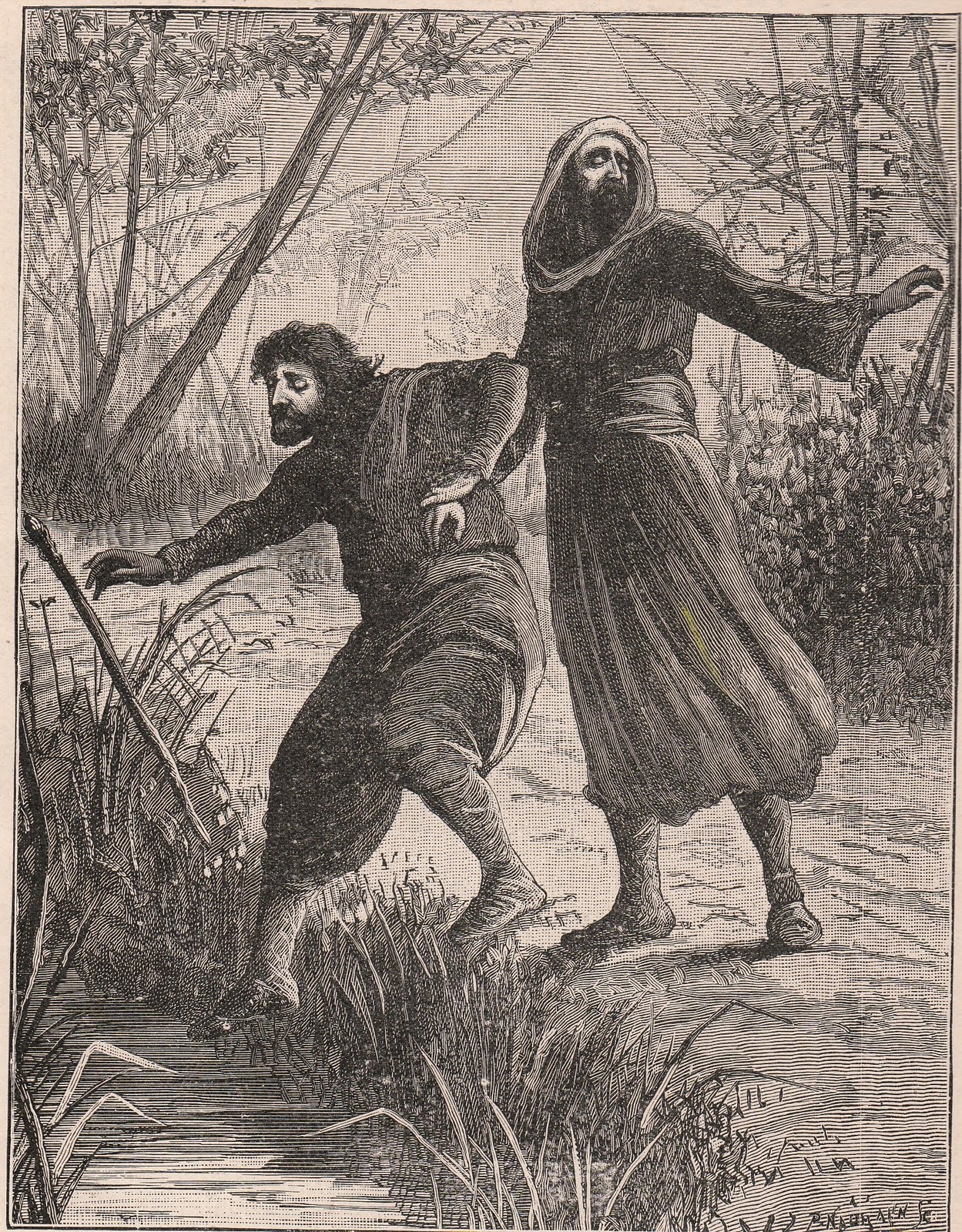
The Blind leading the Blind

This is the first in my series on parables, proverbs and biblical myths (as some people would say).


Parable
Jesus said "Love your enemies, and do good, and lend, hoping for nothing again, and your reward shall be great, and you shall be the children of the Highest; for He is kind unto the unthankful and to the evil.

"Be ye therefore merciful, as your Father also is merciful.

"Judge not, and ye shall not be judged: condemn not, and ye shall not be condemned: forgive, and ye shall be forgiven:

"Give, and it shall be given unto you; good measure pressed down, and shaken together, and running over, shall men give into your bosom.

"For with the same measure that ye mete withal it shall be measured to you again.

"And He spake a parable unto them, Can the blind lead the blind? shall they not both fall into the ditch?"

Proverbs
"If the blind lead the blind, both shall fall into the ditch." 
When a person lacking in understanding or expertise attempts to guide another like himself, both will suffer serious consequences.
"There are none so blind as those who will not see."
It is pointless reasoning with a person who does not want to listen to sense.

Spiritual Blindness
Physical blindness gives people an image of helplessness and despair, but no one seems to recognise fully what spiritual blindness is.

Figuratively, blindness refers to an inability to recognise the truth. It can range from people who simply do not want to know to those who exercise it as a culpable condition, such as the judges whose judgment is perverted because of bribes.

Such blindness to the truth results in mental confusion where an individual has forfeited the ability to perceive truth at their own cost.

Paul in the New Testament describes gradual blindness when he writes of those whose 'foolish hearts were darkened.' (Roms 1:21). In another view he talks of seeing poorly now in contrast to seeing perfectly in the life to come (1 Cor 13: 12); as in dim glass.

Jesus described in the religious leaders and teachers of his own generation in terms of blindness (Mt 15:14, 23: 16-17, 19, 24, 26). The irony of their situation is that in their spiritual ignorance they assumed that they understand perfectly.

Similarly, Christian believers who revert to their pre-Christian ways are described as blind, not perceiving the contradiction expressed in their behaviour, (2 Pet 1:9, 1 Jn 2:11).

The Pharisees and Pharisaical Actions
Commonly thought of as hypocrite. Pharisaical means marked by hypocritical censorious self-righteousness. The etymology of hypocrite suggests 'a pretender'. In Hebrew culture the Pharisees pretended to be the authoritative opinion on righteousness and the law.

They are model citizen of Israel, accepted leaders simply by virtue of their zeal for the law. Sound familiar?

So why did they hate Jesus so? If you read the parable above, the Pharisees did not follow the spirit of the law, but the letter. The Pharisees did not act like that parable. Jesus challenges their right to their assumed position and exposes their pretense and emerges as a higher authority than them.

The pharisees had zeal but no knowledge of the mystery of the kingdom. Even the prophet Isaiah has spoken about the Pharisaic ardor for the details of the law when he said "So then, the word of the lord to them will become: Do and do, do and do, rule on rule, rule on rule; a little here, a little there – so that they will go and fall backward, be inured and snared and capture." (Is 28:13 NIV).

They are foremost interested in the restoration of Israel. They are politically influential. For this reason we find them to be the foremost inquisitors and dialogue partners of Jesus. Jesus accuses them of abusing their power: "devouring widows' houses" (Mk 12: 40), taking the best synagogue seats (Mt 23:6), expecting dutiful marketplace greetings and the title Rabbi (Mk 23:7).

Jesus says they are blind guides. Blinded by pride to the complete perspective. Their myopic vision of the law leads eventually to a decline in popular opinion and immediately to the harsh judgement of Jesus "You blind guides! You strain out a gnat but swallow a camel" (Mt 23:24 NIV).


Thought they are considered expert exegetes in the nuance of the law, Jesus condemns them as teachers of the law for expanding its intentions. While they take offense to this sabbath healing of a man with a withered hand (Mk 3:1 - 5), he refers to the written law and scorns extrapolations (Mk 2:27). He claims their traditions make void the word of God (Mk 7:13) by focusing on minute details and missing the larger purpose.  "Woe to you, teachers of the law and Pharisees, you hypocrites! You give a tenth of your spices - mint, dill and cummin. But you have neglected the more important matters of the law – justice, mercy and faithfulness." (Mt 23:23 NIV).

The Pharisees are offended when Jesus eats with tax collectors and prostitutes. Intent on separation from all defilement, the Pharisees have applied to their table fellowship the laws prescribed for priests and sacrifices. To emphasise their insufficient efforts at purity, Jesus call the Pharisees "whitewashed tombs, which on the outside look beautiful, but on the inside … are full of the bones of the dead." (Mt 23: 27 NRSV).

It was the pharisees that used their political and religious cloud for revenge; with priestly roles and political connections, they encourage his trial and crucifixion.

For those in spiritual blindness Jesus said "Forgive them, for they do not know what they are doing." (Lk 23: 34).

Please check my visual narrative As Blind as a Bat (Phantasmagoria.thecomicseries.com/comics/pl/97574). It has another story about Jesus healing on the Sabbath Day and will give you a clear idea of what self-righteousness really is. The pharisees accused Jesus of casting out devils by Beelzebub the prince of the devils. To the clear moral vision of Jesus the attitude implied in this objection showed a radical depravicty of nature, an inability to discriminate between fundamental ethical distinctions. The former blind man says "Whereas I was blind, now I see. This man has done good to me, and for me, therefore, he is good." It is not the function of the prince of darkness to give sight to the bound.

Blind leading the Blind

in The Maze of the Labyrinths

SO here it finally is! Phantasmagoria in the maze of the labyrinths. Yes, make your choice --- the road less travelled or the wide road?

The Maze of the Labyrinths
These labyrinth's are filled with symbolism.

Tree of Life (evergreen tree is immortality of the soul) in the middle vs the minotaur (but there is always salvation from that even if that road is taken) - the sword (spiritual weapon).

Crown of thorns: Jesus and persecution.

Grapes: for nourishment. The Eucharist.

Ivy: faithfulness, eternal life.

Crown: reward and eternal life.

Beehive: honeyed words.

Egg: resurrection

Chain: imprisonment; broken chains - liberation.

Lamp: Truth, light, divine inspiration. Word of God.

Water: purification.

Swallow: because it hides itself in the mud during winter, the incarnation. Because of its return in the spring, resurrection.

Butterfly: transformation and resurrection.